
The reason why we still need stories alongside hard facts
It’s been that way since the end of September: the EmpCo Directive is now in force. As we discussed in our article – Climate Neutral’ was yesterday, what the EmpCo Directive will change now – we’ve known since this spring that sustainability-related claims must now always be well thought out and, above all, backed by evidence. The goal is to reduce any form of greenwashing and to provide end customers with greater clarity and guidance once again. Recently, lawsuits against companies such as Katjes1 have received significant press coverage.
But what else does all of this actually entail? What remains when the simple slogans are stripped away? This is precisely where this article comes in: without the right stories, there isn’t much left of sustainability communication.
The sustainability report covers a wide range of topics, but there is still much more to be said
While the “traditional” sustainability report is often produced out of a sense of obligation and read by stakeholders such as banks or investors, communication around sustainability is far more complex. No matter how far along a company is in this area—it usually has many different stakeholders who place varying demands on the company. Although each group requires different communication approaches and channels, there are also some very fundamental challenges today.
Why Communicating Sustainability Has Become So Difficult Today
Two developments are currently making it particularly difficult for companies to make headway on sustainability issues: the paradox of evidence and the collapse of the so-called “knowledge deficit” model.
Although climate change, for example, is clearly scientifically proven, action on the issue has stalled. The paradox of evidence2 describes three reasons that are at work simultaneously.

The knowledge deficit model3 long assumed that more information or knowledge directly leads to more action. Current research refutes this. People evaluate facts—no matter how well-documented—through the lens of their identity, and they act based on social considerations, their identity, and how effective their actions appear to be—not based on how much they know. This is called motivated reasoning.
Furthermore, much of sustainability communication is trite, and media coverage is often polarizing. Greenwashing has further eroded trust, which is now lacking. And emotions like fear, shame, or guilt have little chance of success in the sustainability context—we’re already bombarded with enough of them in the media as it is.
The question remains: What stories can make sustainability engaging, trustworthy, and tangible again—far beyond the CSRD or VSME reports, which reach only a small fraction of stakeholders anyway?
Why Stories Work Where Facts Fail
There’s no question that there are real stories waiting to be told. The real challenge is how to tell them. Successful storytelling manages to convey even complex topics effectively.
Why stories and not just facts? Three reasons: Stories activate sensory and motor areas of the brain, they appeal to emotions, and they create meaning by providing context and significance.
You could also call this a cognitive hack4. Good storytelling connects three levels:
- Emotions, because feelings connect content with personal meaning.
- Attention, because stories create a focus on the narrative.
- Imagination, because it transports us to another world for a moment.
When it comes to complex topics, stories can serve a purpose similar to that of Google Maps: they provide context where raw facts alone cannot.
Four Emotions That Matter in Sustainability Communication
In sustainability communication, four emotions are particularly relevant, and each has a different effect.
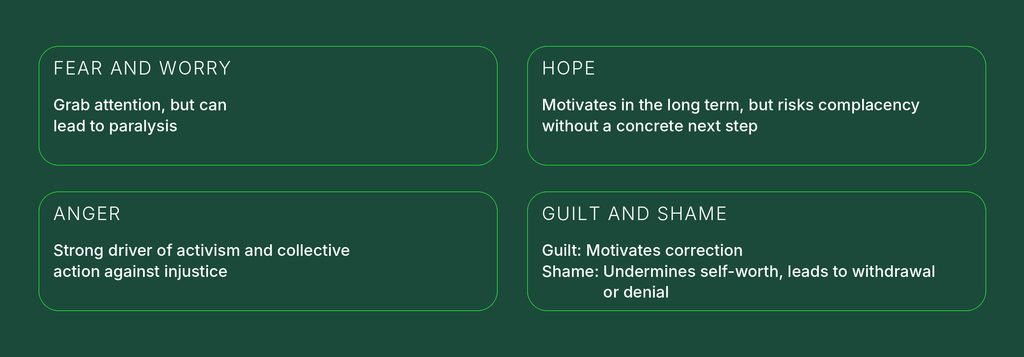
Those who understand these effects can make more informed decisions about which emotion is best suited to a particular goal—and which is not.
Every story needs a clear goal
Ultimately, every company needs to reach its various stakeholder groups through the right medium and with the right message. The key question is: What message will truly resonate with this group?
To do this, every story needs a goal. These goals are typically:
- Awareness: Generating attention, putting an issue on the agenda; measurable in terms of conversations, inquiries, reach, and media coverage
- Trust: Gaining approval, building credibility, as reflected in internal approval, stakeholder feedback, and reputation metrics
- Objective: To foster commitment and drive specific behavior, as measured by decisions, conversions, and behavioral changes
So, is the goal to reach employees in order to raise awareness of your own sustainability efforts? Is it about building trust? Or is the aim to encourage specific actions through direct engagement with end customers? Questions like these can help clarify your own “reason why.” Once the goal is defined, you can begin developing the story. The next article will cover exactly what happens next once the objective has been set—and why the EmpCo guideline can actually be an opportunity.
What stories lie behind your sustainability work?
We can help you define the purpose of each story and tell it in a way that resonates with your stakeholders and meets the requirements of the EmpCo guidelines.
Get in touch – we look forward to hearing from you.

May-Britt Bombe
Senior Sustainability Consultant

- https://www.bundesgerichtshof.de/SharedDocs/Pressemitteilungen/DE/2024/2024138.html, https://www.tagesschau.de/wirtschaft/bgh-werbung-klimaneutral-102.html ↩︎
- IPCC (2017), Communications Handbook for IPCC Authors.https://www.ipcc.ch/site/assets/uploads/2017/08/Climate-Outreach-IPCCcommunications-handbook.pdf
Kollmuss, A., & Agyeman, J. (2002), Mind the Gap: Why do people act environmentally and what are the barriers to pro-environmental behavior? Environmental Education Research, 8(3), 239–260 https://doi.org/10.1080/13504620220145401
van der Linden, S. (2015), The social-psychological determinants of climate change risk perceptions.Journal of Environmental Psychology, 41, 112–124. https://doi.org/10.1016/j.jenvp.2014.11.012 ↩︎ - Kollmuss, A., & Agyeman, J. (2002), Mind the Gap: Why do people act environmentally and what are the barriers to pro-environmental behavior? Environmental Education Research, 8(3), 239–260 https://doi.org/10.1080/13504620220145401
Kahan, D. M. (2013). Ideology, motivated reasoning, and cognitive reflection. Judgment and Decision Making. (Original-PDF bei Cambridge): https://www.cambridge.org/core/services/aop-cambridgecore/content/view/F8A6A74C9022363D672B0FD14DD8B89F/S1930297500005271a.pdf/ideology-motivated-reasoning-and-cognitivereflection.Pdf
Steg, L., Bolderdijk, J. W., Keizer, K., & Perlaviciute, G. (2014), An integrated framework for encouraging pro-environmental behaviour,
Journal of Environmental Psychology, 38, 104–115, https://doi.org/10.1016/j.jenvp.2014.01.002 ↩︎ - Green, M. C., & Brock, T. C. (2000) The role of transporta.on in the persuasiveness of public narra.ves. Journal of Personality and Social Psychology, 79(5), 701–721. h5ps://doi.org/10.1037/0022-3514.79.5.701 ↩︎
