
Holistic ESG & climate consulting
Strategy, reporting and decarbonisation from a single source.
We shape your ESG journey pragmatically,
sustainably and in regulatory compliance
Sustainability is today one of the decisive factors for long-term successful business development. Holistic management of ESG factors (Environmental, Social, Governance) is central to this.
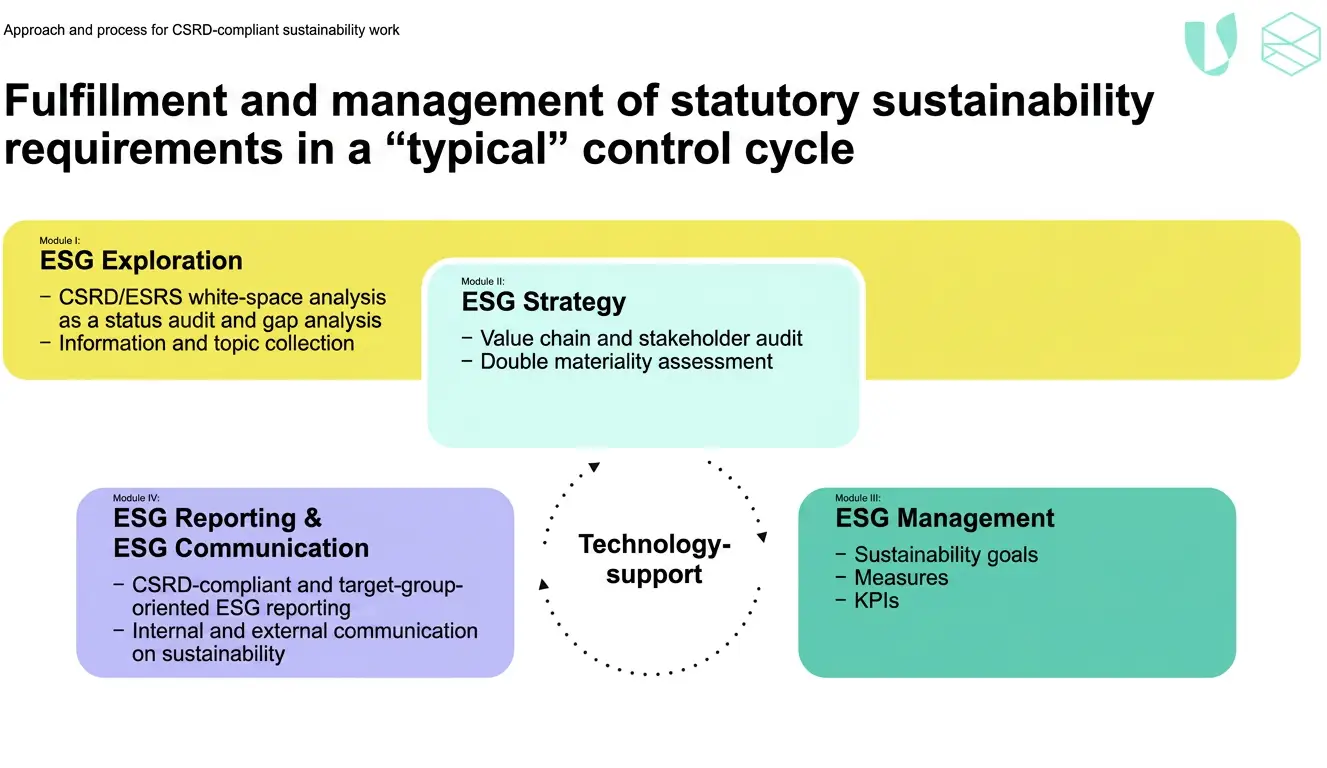
We support corporate clients from a wide range of industries in the successful (further) development of their ESG activities. From analysing the ESG status (gap analysis), through conducting the Double Materiality Assessment (DMA) and developing a company-wide sustainability strategy, to an action-based ESG roadmap — what is known as ESG management. Throughout, suitable and legally compliant non-financial performance indicators remain at the centre of everything we do.
The aim is to implement ESG and climate strategies effectively — from analysis through strategy development to reporting under CSRD and ESRS, or VSME.
Our consultants combine regulatory expertise, communication skills and the ability to deliver. The result are solutions that not only meet standards but achieve measurable impact.
Where does your company stand on ESG — and where is action specifically needed?
With our ESG gap analysis we give you a structured overview of your current level of maturity. We identify gaps, opportunities and fields of action along your value chain — measured against CSRD, ESRS and the EU Taxonomy. The result: a clear picture of your status quo, prioritised measures and a roadmap that fits the size of your company.
How do you develop an ESG strategy that creates economic value?
Sustainability that pays off: companies that anchor ESG strategically achieve a measurable return on sustainable investment — through efficiency gains, better access to capital markets and greater economic resilience. We conduct the Double Materiality Assessment (DMA) in accordance with ESRS 1 & 2 — as part of our IDW-certified approach — and build on it to develop an integrated ESG strategy with clear targets, measures and KPIs. → More on this topic: ESG as a strategic success factor
How do you meet your CSRD reporting obligation — legally sound, audit-proof and communicatively strong?
Whether CSRD, ESRS, VSME or the EU Taxonomy: we translate complex regulatory requirements into comprehensible, audit-proof sustainability reports. Our consultants combine ESG expertise with many years of communication and reporting competence — the result are reports that convince auditors while also speaking to investors, employees and the public.
May your company still say “climate neutral” — and what happens if it may not?
From September 2026, new rules against greenwashing apply in Germany: the EmpCo Directive prohibits blanket sustainability claims without robust, externally validated evidence. Terms such as “climate neutral”, “environmentally friendly” or “green” are only permitted if they are demonstrably substantiated. Violations carry fines of at least 4 % of annual turnover — plus reputational damage with investors and customers. We review your existing claims, identify high-risk statements and help you make your sustainability communication future-proof and more credible. → More on this topic: “Climate neutral” was yesterday — what the EmpCo Directive changes now
How do you make ESG operationally effective in your corporate management?
An ESG strategy only takes effect when it is anchored in day-to-day business. Without integrated ESG data relevant to steering the company, sustainability targets remain fragmented — and intangible for the CFO and controlling. We support you in building robust ESG processes: from consistent data collection through KPI monitoring to clear governance responsibility. → More on this topic: Data as the foundation of an effective ESG strategy
Which ESG tool suits you — and who helps you choose?
We are tool-agnostic: our consulting is independent of individual software solutions — we always recommend what genuinely fits your requirements, your data situation and the size of your company. Through our partner network we have access to leading ESG platforms such as VERSO, Workiva, Atlas Metrics and SAP Sustainability — for data management, reporting and KPI steering.
What does ESG actually deliver for the CFO — and how does the investment pay off?
ESG is a matter for the top — including for controlling. Well-structured ESG management reduces compliance costs, improves ratings with banks and institutional investors, lowers the cost of capital and secures access to green finance and sustainable debt instruments. We speak both languages: that of the ESG manager and that of the CFO. Our aim is a measurable return on sustainable investment — not compliance on paper. → More on this topic: Sustainable value creation
What else makes for good sustainability communication?
ESG content must not only be correct — it must convince: in investor relations, in the supply chain, internally. We support you in stakeholder dialogue and in developing policies, codes of conduct and climate reduction plans — and we make sure your sustainability content is communicated comprehensibly and credibly for every audience. → More on this topic: Target-Audience-Specific Reporting
With our comprehensive and long-standing experience in corporate reporting, we also offer a holistic and practical approach to communication — whether in the management report or the sustainability report. Our dedicated experts write and develop engaging ESG reports and non-financial statements that people actually want to read. And for our corporate clients’ sustainability communication we work in an integrated way with our communications team, jointly developing convincing concepts to communicate the content clearly and effectively.
We navigate our corporate clients safely through the complex thicket of standards, legal requirements, guidelines, ESG ratings and further initiatives. We also advise you on developing a climate strategy within the framework of the Science Based Targets initiative (SBTi) and on further topics in climate and environmental accounting.
ESG gap analysis
Sustainability is such a multi-faceted subject that companies often do not know where to begin. Regulatory requirements make this even more challenging. We help you gain an initial overview, classify activities undertaken so far, uncover gaps and define a roadmap for your company-specific sustainability journey.
ESG strategy
We support our clients in developing and advancing ESG strategies and implementing them successfully within the company. Conducting the Double Materiality Assessment in particular — part of our IDW-certified approach — helps to define the material sustainability topics for our clients and to address them strategically. The client’s relevant stakeholders are always closely involved.
ESG management and processes
ESG strategies are only the first step. ESG management is about operationalising the strategy — that is, developing targets, measures and KPIs and taking responsibility for the topics. This makes sustainability tangible and sets the course for the future.
ESG reporting
Whether Corporate Sustainability Reporting Directive (CSRD) or Sustainable Finance Disclosure Regulation (SFDR), Sustainable Development Goals (SDGs), UN Global Compact, Principles for Responsible Investment (PRI), European Sustainability Reporting Standards (ESRS), Global Reporting Initiative (GRI) or the German Sustainability Code (DNK): we offer comprehensive support across all areas of sustainability work, including legally compliant reporting. We also help to bring financial and ESG reporting obligations together and to make the right preparations when it comes to integrated reporting.
Use of technology
We have experience with numerous tools and use them to our clients’ advantage. With our sister company VERSO we also have our own tool-based software solution to offer: whether our AI-supported solution for double materiality, our ESG Hub, which simplifies data collection and reporting activities and presents them clearly, or related offerings such as the Climate Hub for climate topics or the Supply Chain Hub for successfully managing your own supply chains.
Further ESG topics
Much of sustainability work is about staying in dialogue with all relevant stakeholders and conveying the genuinely material topics effectively: we provide comprehensive support on stakeholder dialogue and all related subjects that arise from it. These may be codes of conduct, policies to be developed, climate reduction plans and much more. Or it may be about communicating sustainability content convincingly for specific stakeholders in the form of brochures, presentations, placards or posters.
From climate target to measurable impact:
how we support companies on the path to decarbonisation
Climate action is no longer an optional extra — it is a strategic and regulatory necessity. Those who record emissions and can present a credible transition plan secure decisive advantages. These include lower capital costs, better ratings and access to green finance. We support you with well-founded advice and field-tested tools: from the first carbon footprint to integrated climate management.
What does the climate cost us – and what does it cost us if we do nothing?
Climate risks are balance sheet risks. In concrete terms: companies that ignore climate risks underestimate their actual risk exposure. Physical risks such as extreme weather and supply chain disruptions take effect just as transition risks such as carbon pricing and tighter regulation do. Both change margins, valuations and financing conditions. This applies regardless of whether a company emits itself or not.
Those who know these risks can act. That is why we identify and quantify them in your specific corporate context. This creates a robust basis for strategic decisions while at the same time meeting the growing requirements arising from CSRD and TCFD.
How large is your carbon footprint – and where are the biggest levers?
We record the Corporate Carbon Footprint (CCF) in accordance with the GHG Protocol and ISO standards. This covers Scope 1, 2 and 3 emissions, the energy balance and the definition of the reporting boundary.
The result is not a number for the report. Rather, on the basis of the emissions analysis we identify the biggest levers in your company. Together we then define concrete potential for action that is effective both economically and strategically. → More on this topic: GHG Protocol
How do you set credible climate targets – and how do you defend them to investors?
Climate targets not based on recognised methods are increasingly scrutinised by investors, rating agencies and auditors. We therefore develop measurable climate targets with you in line with recognised standards such as the SBTi. We also define realistic decarbonisation measures with a clear time horizon and comprehensible interim targets that withstand any due diligence. → More on this topic: SBTi-validated climate targets
What is a climate transition plan — and when do you need one?
A climate transition plan connects climate strategy and business strategy. It shows how the transition to a low-carbon economy can succeed: with measures, investment requirements, responsibilities and milestones. Under the CSRD it becomes mandatory for many companies.
What matters is genuine anchoring in the business strategy. A transition plan without a link to concrete capex and opex decisions remains a document without effect.
We develop your transition plan so that climate measures are integrated into investment planning and budget processes. Clear priorities, realistic time horizons and comprehensible interim targets. The result is a robust instrument that stands up to internal decisions just as it does to the requirements of capital providers, auditors and stakeholders.
How do you account for your product emissions — and what does the supply chain demand?
Customers, procurement guidelines and requirements such as Scope 3 reporting under the CSRD are increasing the pressure on suppliers. In concrete terms: those who cannot robustly demonstrate the carbon footprint of their products lose contracts or find themselves having to explain.
We prepare Product Carbon Footprints (PCF) in accordance with ISO 14067 and support Environmental Product Declarations (EPDs) as well as Digital Product Declarations (DPDs). These are standardised, auditable forms of evidence that are recognised in tenders, supplier audits and customer communication. The result is not a compulsory exercise but a concrete competitive advantage: with customers who demand climate data, and against competitors without this transparency.
What to do with unavoidable emissions — and how do you communicate that credibly?
The EU directive against greenwashing (EmpCo) fundamentally tightens the requirements for climate-related claims. Anyone using terms such as “climate neutral” or “carbon offset” must substantiate them with a comprehensible reduction pathway and audited data. Those who cannot risk warnings, sanctions and reputational damage.
At the same time, offsetting remains a legitimate instrument — but only as a final step after consistent reduction. We advise you on selecting suitable offsetting projects with audited providers. We also ensure that your climate communication is EmpCo-compliant, legally sound and credible. → More on this topic: Carbon credits
Find out more about our projects
and take a look at the list of corporate clients to date .



Find out more about our service areas Finance / IR and Communications / Design.
