
What makes a good story and how to develop one

“We have switched our production to XY, thereby reducing emissions by XY%.” Sounds boring, abstract and fails to resonate? That’s often the case. What’s more, simple success stories can quickly be perceived as greenwashing. However, it comes across as more authentic when companies also show where they fall short. Highlighting ambiguities – such as the conflict of values between profit and environmental protection – is more convincing in sustainability communication than any polished success story1.
tHE EmpCo-Twist: WHY SUSTAINABILITY COMMUNICATION Can become a key differentiator
This is precisely where the ‘problem’ intersects with the objective of the EmpCo Directive: it aims to actively combat greenwashing and demands that statements once again have greater depth of content. This means that statements such as ‘We have switched our production to XY, thereby reducing emissions by XY%’ require more context and explanation. Whilst this involves some effort, it can pay off: new requirements for supporting evidence can help build trust in future, and genuine sustainability work can once again become a distinguishing feature, rather than getting lost in the sea of interchangeable claims or statements.
Combined with new approaches to your own communication and suitable story ideas, there’s a lot that can be achieved here. How can storytelling overcome the challenges mentioned, and how do you go about crafting the right story?
Storytelling as a way to combat Information Overload
There is a wealth of information available on many topics. Take the energy transition, for example: it is backed by facts and is absolutely essential to halt global warming caused by climate change. Nevertheless, it requires a personal approach, context and genuine relevance for each individual in order to prompt action. Stories therefore offer the opportunity to provide guidance and to translate disorganised information into a meaningful, coherent narrative.
Further topics to be covered in the preparatory work
Once the objective has been established (see part 1), the story needs a basic framework compromising three areas:
- Relevance to the target audience: A story is only effective if it connects with the target audience’s everyday lives. Four questions can help with this:
- What problem, interest or benefit does the target audience have (‘job to be done’)?
- What values do the company and the target audience share, such as safety, fairness, a sense of home or responsibility?
- How can a sense of ‘we’ be created, rather than moralising, in a concrete, local and immediate way?
- And what social normas does the target audience adhere to? The test: would they voluntarily pass the story on? If not, the connection is missing.
- Facts & figures: These make a story credible and robust. What data does it rely on, and what needs to be researched? If the facts are vague, the story can quickly seem inconsistent or become open to criticism.
- Areas for action: If you want to encourage people to take action, you need clear calls to action with specific, easy-to-follow steps that instil a sense of self-efficacy. Instead of ‘saving the climate’, this could, for example, involve calculating one’s own carbon footprint. A good story should show the impact that each individual’s actions can have.
Only then can a decision be made as to whether the story can be told. This involves clarifying the conditions or defining the boundaries.
And that’s not all: self-reflection is essential
Of course, even those who develop the story are not free from prejudices, assumptions, values or ideals. That is why it is worth consciously questioning one’s own role in the process. Once that reflection is complete, things can really get underway.
The story first, then the channel
We often think straight away in terms of formats, such as an Instagram Reel or an article on the intranet. This is a habit we’ve picked up, but it doesn’t put the message first. The right channel is chosen based on the context of the story, not the other way round. But what exactly does a story consist of?
The Storytelling Canvas, as a foundation, highlights the various elements of a story:
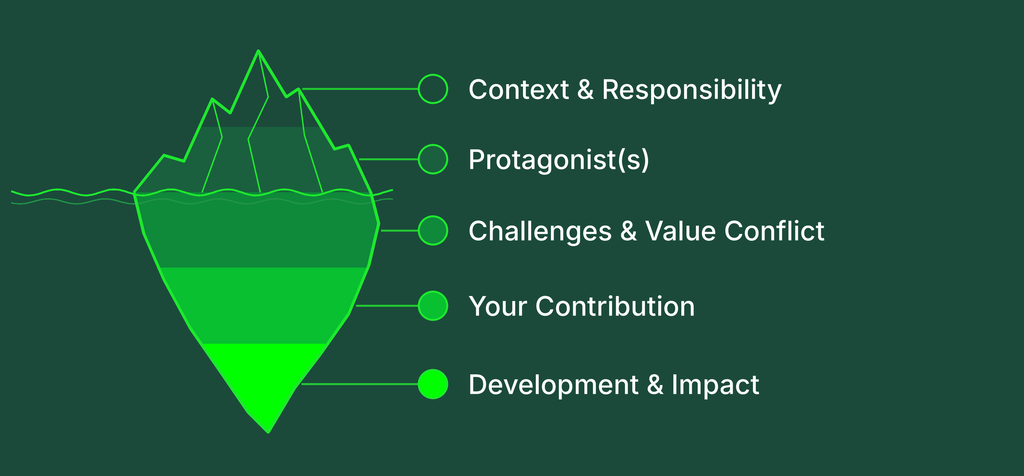
Every story needs a conflict
For a story to work, it needs, just like any good book, a surprising twist or a conflict that needs to be resolved. Whatever the specifics may be, the conflict is at the heart of every story.
a real-life example
A fictional story centred on the energy supplier Mainova and the football club Eintracht Frankfurt was created during a storytelling workshop. The aim was to promote the take-up of electricity tariffs based on renewable energy sources. Mainova is a sponsor of Eintracht.
Uwe, an Eintracht fan in the standing section who’s price-conscious, opens his electricity bill and is annoyed: it’s gone up again. He’s never been interested in renewable energy before, but he’s all the more passionate about his club. That evening, he’s at the stadium; the match is heated, and a goal is scored. During a break in play, his gaze lingers on the hoarding: ‘Energy from Frankfurt. For Eintracht.’
There are various ways to interpret what this sentence triggers in Uwe, what exactly his conflict is, and where his journey home takes him. What is clear is that a sense of regional belonging lies at the heart of the story.
conclusion
EmpCo makes sustainability communication more labour-intensive, but not worse. Those who have to back up their claims end up with more to say than just a percentage figure. A good story therefore begins with preparatory work: it connects with the target audience’s everyday lives, is based on reliable data, and shows what each and every individual can do in practical terms. This involves taking an honest look at one’s own assumptions. Only then does the choice of channel come into play. At its core, every story needs a conflict, and this may well include the fact that not everything goes to plan. You’re far more likely to reach football fan Uwe through his club and his town than through a carbon footprint analysis.
Already an idea in mind?
After all that, would you like to get started yourself and develop a story? Go ahead! We’d be happy to advise you and guide you through a structured process, from the broad theme of the story right through to the call to action. Along the way, we’ll ask critical questions and find the right way to address your target audiences.
Contact us – we look foward to hearing from you.

May-Britt Bombe
Senior Sustainability Consultant

- Furnham, A., & Marks, J. (2013). Tolerance of Ambiguity: A Review of the Recent Literature. Psychology, 4, 717. https://doi.org/10.4236/psych.2013.49102 ↩︎
