
Who Is It Actually For? Why ESG Communication Needs More Than a CSRD Report

With the introduction of the CSRD, the complexity of sustainability reporting is increasing significantly. Companies are now required to disclose ESG data more comprehensively and transparently than ever before.
However, a comprehensive sustainability report does not automatically reach all relevant target groups. Customers, business partners, applicants, and employees often need much faster and more accessible access to ESG-related topics.
This is exactly where sustainability brochures are becoming increasingly important: they complement formal reporting with a communication format that condenses complex content, presents it in an understandable way, and tailors it to specific audiences.
The question is therefore no longer just whether companies should communicate sustainability — but above all: for whom?
Who Sustainability Brochures are intended for
The requirements for sustainability communication differ significantly depending on the target audience. This is precisely why an additional communication format can make strategic sense. Different stakeholders prioritize different expectations:
- Customers and business partners seek transparency on topics such as climate action, supply chain responsibility, and ESG strategies.
- Applicants and employees want to understand how credibly sustainability is embedded within the company.
- The public and the media require a quick and accessible overview, as well as context for relevant ESG topics and developments.
- Investors and analysts benefit from a concise classification of strategic progress and key performance indicators.
Sustainability Brochures are not a “Light Version” of the report
One common misconception is to view sustainability brochures as simplified summaries of the CSRD report. In reality, the two formats serve different purposes.
While the sustainability report fulfills regulatory requirements, the brochure serves a communicative function. It provides orientation, connects data with narratives, and makes sustainability strategies easier to understand.
For this very reason, sustainability brochures can become an important complement within modern ESG communication.
Why Sustainability Brochures create strategic value
Well-structured sustainability communication today serves far more than mere disclosure obligations. Sustainability brochures can help companies to:
- Make complex ESG content easier to understand through clear structures and visual accessibility.
- Make sustainability strategically visible by communicating not only KPIs, but also values, ambitions, and long-term goals..
- Reuse content across channels, including websites, social media, recruiting, sales, trade fairs, and investor relations materials.
As a result, ESG topics are no longer communicated in isolation but become more deeply integrated into overall corporate communications.
Practical Example: Nordex Group’s “Sustainability Facts 2025”
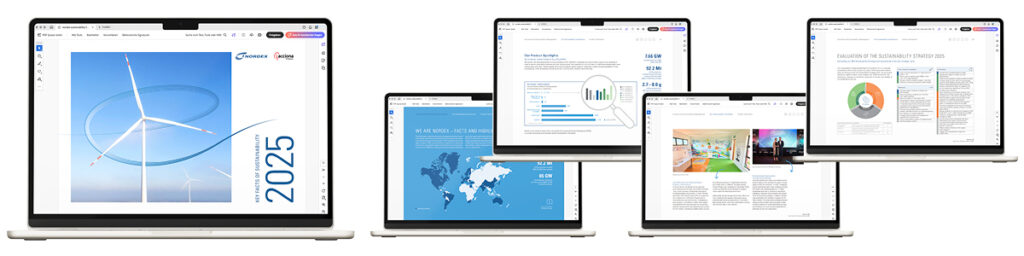
The Nordex Group’s “Sustainability Facts 2025” demonstrates how companies can complement formal reporting with additional sustainability communication formats.
The publication summarizes key ESG topics and KPIs in a compact format and is specifically designed for different stakeholder groups. Rather than focusing on regulatory detail, the emphasis is placed on clearly communicating strategic developments.
This example illustrates how sustainability brochures can translate complex ESG reporting into an accessible communication format.
Risks companies should consider
As relevant as sustainability brochures may be, they also involve communicative risks. Companies should pay particular attention to the following:
- Avoiding greenwashing: statements should be transparent, verifiable, and data-based.
- Ensuring consistency with official reporting: the brochure and sustainability report must be based on the same data foundation.
- Avoiding overly promotional language: credible ESG communication combines transparency, strategy, and reliable information.
- Condensing content responsibly: a sustainability brochure should provide orientation without oversimplifying complex issues..
This is why success depends on striking the right balance between clarity, credibility, and strategic communication.
“Sustainability reports document ESG performance.
Sustainability brochures make it understandable.”
Our conclusion: Sustainability brochures complement regulatory reporting with what ESG data alone often cannot provide: clarity, context, and audience-oriented communication.
Because sustainable corporate communication does not end with fulfilling reporting obligations. What truly matters is whether the content is understood — and whether it builds trust.

Anna-Lena Mayer
New Business Director

